The 3 AM Gift
The night waking isn't the problem. Your relationship to it is.
Featured Affirmation Playlist
Night Waking Stillness
29 affirmations · sleep · Luna voice · 20 min
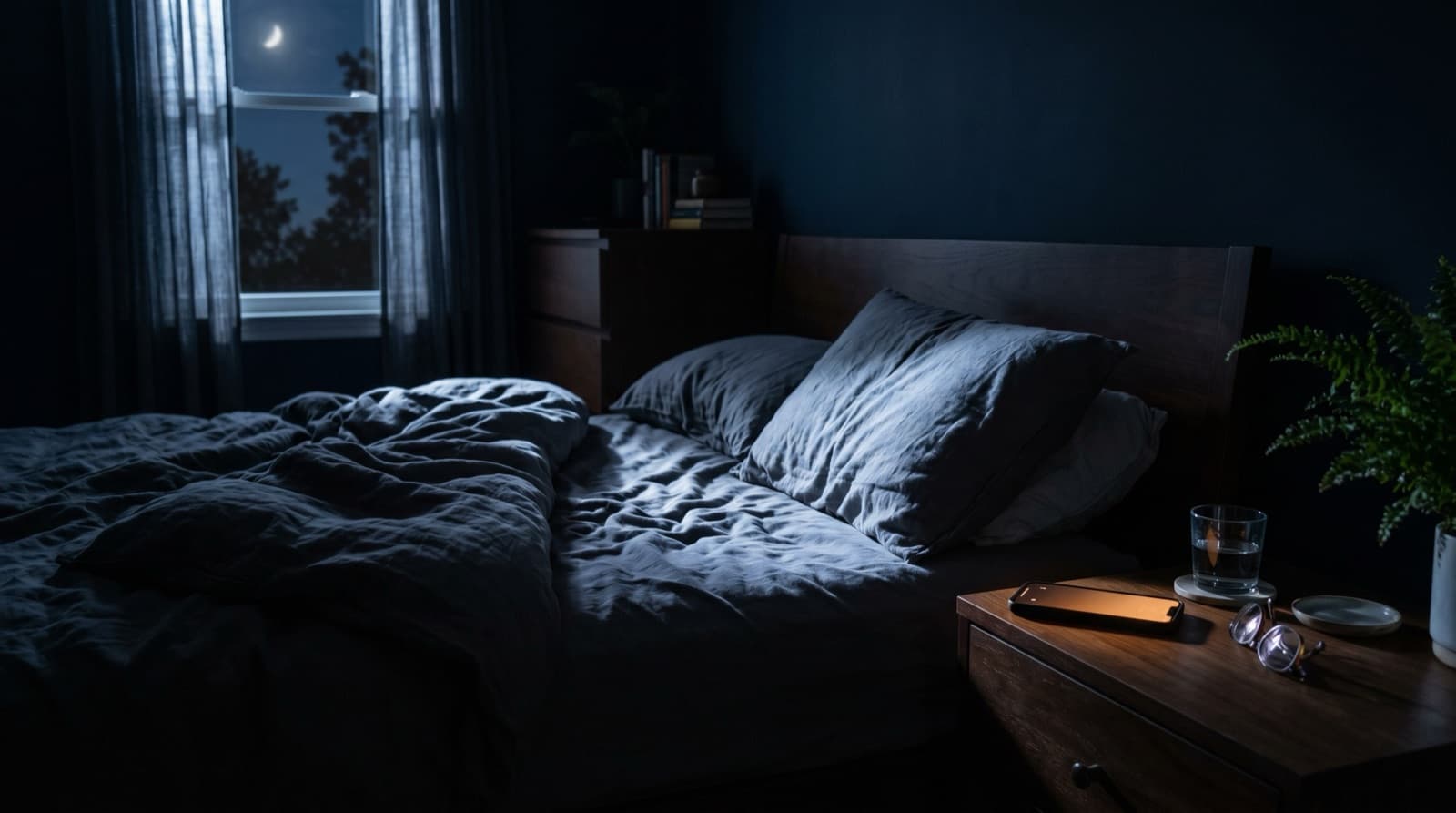
You know the moment. You surface at 2 or 3 in the morning, and before you've even opened your eyes, the arithmetic starts. How many hours until the alarm. Whether you can function on what you've got so far. Your brain, which was supposed to be offline, decides this is the perfect time to audit every open thread in your life.
What happens next is almost always the same. You try to fall back asleep. You try harder. You get frustrated that trying isn't working. And that frustration is the thing actually keeping you up.
Sleep researchers call this the effort paradox. Colin Espie's work at Oxford found that deliberate effort to sleep is one of the strongest predictors of insomnia. Sleep is involuntary. You cannot produce it by trying. The harder you grip, the further it slides.
Most advice about night waking treats it as a malfunction to fix. Better sleep hygiene, less caffeine, a cooler room. All fine, all limited, and none of it touches the part that's actually working you over at 3am: the self-talk. The loop. The negotiation with your own brain about a situation you can't think your way out of.
So here's the question worth sitting with. What if the waking itself isn't the problem?
For most of human history, sleeping in one unbroken block was the exception, not the rule. The historian A. Roger Ekirch spent 16 years in the records (court documents, diaries, medical texts across 500 years) and found that people routinely slept in two phases. A first sleep, a quiet waking interval of an hour or two, then a second sleep. They used the gap for prayer, reflection, conversation, or just lying still in the dark.
Benedictine monks built a practice around it. Matins and Vigils were prayers written for the watch between sleeps. The waking wasn't a disorder. It was sacred time.
The pattern faded with gas street lighting in the early 1800s and disappeared under electric light. We compressed sleep into a single block, then pathologized anything that strayed from it. The biology didn't get the memo. Matthew Walker's research confirms that brief awakenings between sleep cycles are normal human physiology. The waking is not the problem. What you do with it is.
So try a different move. Instead of fighting the waking, use it.
Andrew Huberman recommends Non-Sleep Deep Rest (yoga nidra) when you wake in the night. Not to force yourself back under, but because deep relaxation is restorative on its own. A 2002 PET study (Kjaer et al., Cognitive Brain Research) found that yoga nidra produced a 65% increase in endogenous dopamine release. Your nervous system doesn't need you unconscious to do its repair work. It needs you to stop fighting.
Here's the shape of it. When you surface at 3am, instead of clenching against it, you let it be. You breathe. You scan your body, release each muscle group, let your weight sink into the mattress. You treat this as your quiet hour, not a crisis. Maybe you find something close to sacred in it. Maybe it's just deeply peaceful. Either way you're resting, not performing unconsciousness on command.
A note from the founder.
I tried this at 1:40 one morning last May. I'd been staring at the ceiling doing exactly what I described above: the arithmetic, the frustration, the loop. So I opened Neuralingual and typed an intent, roughly:
"When I wake in the night, I've been given a gift. This is the quiet hour between sleeps. I don't need to fight back to sleep. I relax completely into this moment. My body restores itself through deep rest. This is my time for stillness, presence, and peace. Sleep will come when it's ready. I'm already resting."
It built a playlist of 29 affirmations around that intent. A few that stopped me:
- "This waking is not a malfunction. It is a rhythm my body remembers."
- "For centuries, men lay in this same dark, unhurried, between one sleep and the next."
- "I catch myself doing the math on lost sleep, and I put the calculator down."
- "I don't negotiate with tomorrow at 2 a.m. Tomorrow can wait."
Without being prompted, it drew on Ekirch's history, Kabat-Zinn's body scan, and Walker's sleep science, and grouped the lines into Recognition, Release, Presence, and Trust. I rendered it as a sleep session, put in my earbuds, and listened. Somewhere around "my shoulders drop, my jaw unclenches, there is nothing to hold up right now," I stopped tracking time. I don't know when I fell asleep. I know I stopped caring whether I did.
(Dave, founder)
That's the whole reframe. The 3am wake-up isn't a failure of sleep. It's a moment where you get to choose what your inner voice says. Most nights the default runs the worry loop: the emails, the money, whether you're doing enough. You didn't choose that voice. It got installed by whatever the last few waking hours deposited.
You can choose a different one. A voice that says "this is a rhythm my body remembers" instead of "I'm going to be wrecked tomorrow." Presence over arithmetic. Rest over performance. Not the first night, probably. This is a practice, and practice means reps: a few nights, then a few more, until the calmer line is the one that shows up on its own at 3am, before you've decided anything.
That's what Neuralingual is for here. Not a sleep aid. A voice aid. Something to reach for at 3am that changes what happens next.
The night waking isn't the problem. It might be the gift.
Get posts like this in your inbox
Occasional writing about affirmations, intentional self-development, and building AI tools. No spam, unsubscribe anytime.
Subscribe