Why I Built Neuralingual
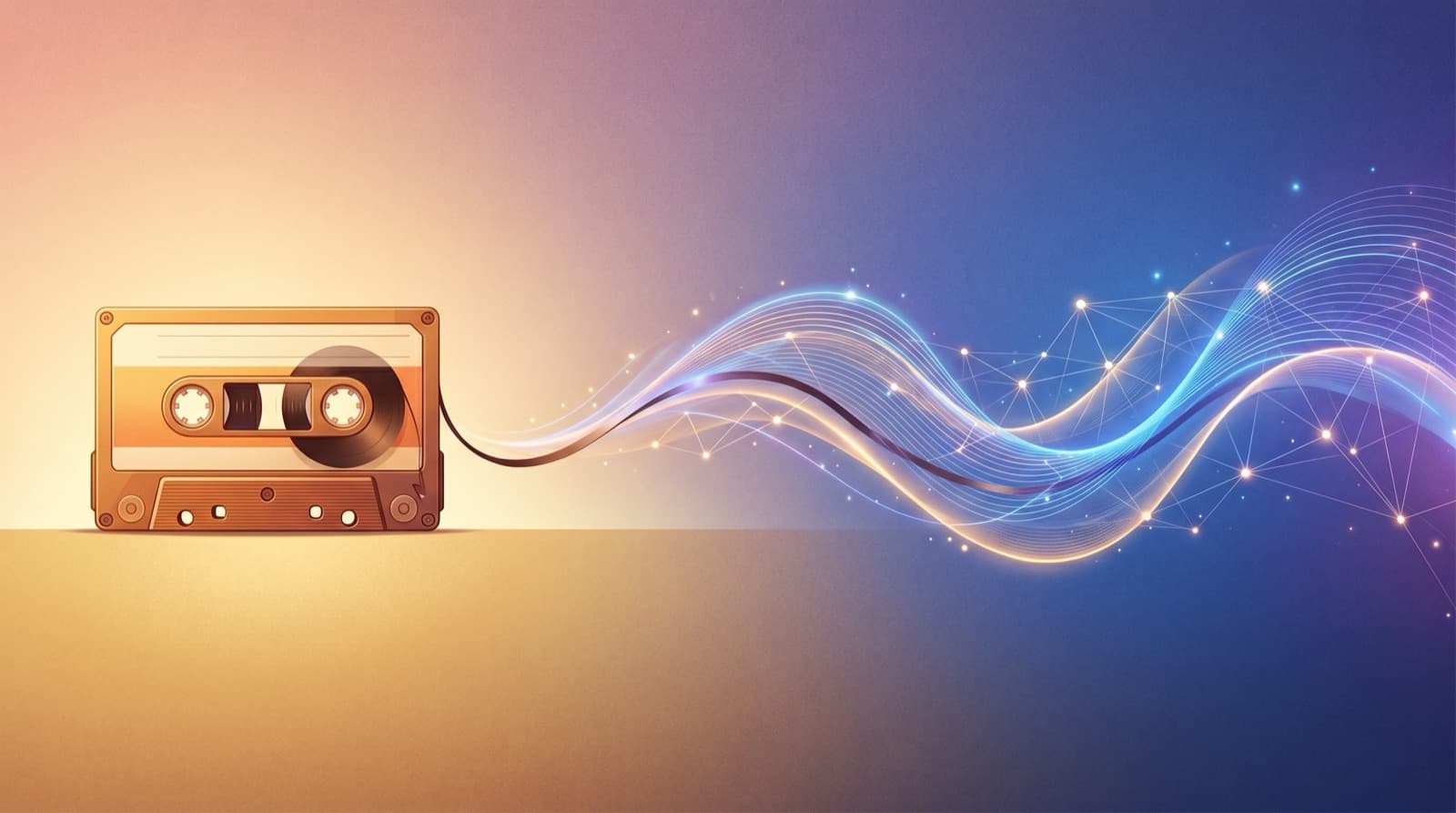
From Cassette Tapes to Claude Code
Most of your inner dialogue isn't something you chose. It was installed by algorithms, old habits, other people's expectations, and whatever the last three hours of screen time deposited. The attention economy is laying grooves in your nervous system whether you attend to the process or not. Neurons that fire together wire together. Your brain doesn't care whether the groove being laid is the one you want. It just lays it in.
I think a lot of people feel this. A vague sense of being pulled in a direction they didn't pick. Not by anything dramatic. Just by the accumulation of inputs they never consciously selected. The scroll, the feed, the notification, the loop. Day after day, groove after groove.
I built Neuralingual because I wanted a tool that works in the other direction. A way to choose which grooves get laid.
I started using affirmations in the 1980s. Literally a cassette tape player with press-down buttons, playing in my car with the windows up, hoping nobody at the stoplight could hear it. One time I was driving with four coworkers and the tape started on its own. Not music. My affirmation tape. The one I'd recorded myself, in my own voice.
"I am 165 pounds. I am handsome and articulate."
Complete silence, and then the kind of laughter that doesn't stop for a while. I ejected the tape. I did not explain what it was. I'm not sure I could have.
But I didn't stop making them. I have always believed in setting intentions and then letting them go. Get specific about the person you're becoming, then release the grip and let your brain's filter do the work. I don't have a complete scientific explanation for why this works. I have hypotheses. I also have decades of watching it work.
The cassette tapes were crude. You had to write the affirmations yourself, record them yourself, rewind them yourself. The practice was real but the tool was barely functional. I kept waiting for something better to show up.
Nothing did. For about forty years, nothing did.
Then AI happened.
I've spent my career building software across a lot of contexts: Microsoft, BEA Systems during the dot-com boom, database infrastructure, distributed systems, running engineering teams across three continents. When Claude Code landed, I wasn't thinking about a company. I was thinking about the cassette tape. Specifically: what if I could describe what I was working on, in plain language, and something intelligent could compose a real affirmation practice from it? Not generic "you are worthy" filler. Affirmations grounded in the actual researchers who study how self-talk, identity, and attention work. Burns, Kabat-Zinn, Bandura, Seligman, Dweck, Rotella, Neff. People who spent careers figuring out what the cassette tape was trying to do.
Not a business plan. Not a market analysis. Just: I could build the thing I'd been wishing existed since Reagan was president. So I did.
Neuralingual takes your intent (a goal, an identity you're stepping into, a skill you're developing) and composes a complete spoken affirmation practice. The AI draws from real frameworks in psychology and performance science. It renders the practice as production audio in your choice of 80+ voices, with background music, binaural beats, and session contexts that shape the pacing and energy to match what you're doing. Sleep sounds different from workout sounds different from walking sounds different from pre-competition. Three tonal registers (grounded, open, mystical) because the same affirmation lands differently depending on how it's spoken. You control everything, or you take the defaults and just press play.
The science is interesting. Self-affirmation measurably reduces cortisol under stress (Creswell et al., 2005). A 2025 meta-analysis across 67 studies and 17,700 participants found consistent effects on well-being and self-perception. The mechanism is attentional: affirmations direct your brain's filter toward what matters to you. I'm not making clinical claims. But the research gave me enough confidence that building this wasn't crazy.
I walk my greyhound Yula most mornings. She's an ex-racer from Australia, racing name Paws Crossed, and she sets a pace that gives you plenty of time to think. She walks slowly and sniffs everything, which turns out to be perfect for listening. Some mornings I'll play an affirmation session during the walk. Before sleep, sometimes I'll create a session targeted at whatever is keeping me up. On the driving range, I've played affirmations through earbuds while hitting balls, directly associating the language with the physical motion.
I don't do it every time. But when I do, the pattern is the same. You notice something you want to work on. You describe it. You listen. And over days, the noticing sharpens. You don't wake up fixed. You wake up more aware of the gap between where you are and where you want to be. That awareness is the prerequisite for the growth.
I know AI is feared. Many of those fears are rational. But not every application of AI has to be about replacing people or optimizing engagement metrics. Some of it can be AI for good. A tool that helps you think the thoughts you actually want to think. A way to push back against the grooves being laid without your permission.
NL is a liberating tool. My motivation is not profit, it is impact, it is value. I built it because I needed it. I'm sharing it because I think other people might need it too. An opportunity to seize agency, in literally any arena of life, and intentionally move in that direction instead of wherever the current is taking you.
Neuralingual is the first product from Inner Stack Labs, a company I founded to build AI tools for intentional self-development. I built it with Claude Code, Codex, and Gemini CLI. More than 2,000 pull requests merged. Bootstrapped with about the same amount of investment as a business trip.
I'll be writing here about what I'm learning: the science behind affirmations, specific use cases, what building an AI-native product actually looks like, and whether any of this works for people who aren't me. I genuinely don't know the answer to that last one yet. That's what I'm trying to find out.
If it resonates, follow along. If it doesn't, no hard feelings. But I suspect some of you have been waiting a long time for the cassette-tape idea to actually work.
Get posts like this in your inbox
Occasional writing about affirmations, intentional self-development, and building AI tools. No spam, unsubscribe anytime.
SubscribeGet posts like this in your inbox
Occasional writing about affirmations, intentional self-development, and building AI tools. No spam, unsubscribe anytime.
Subscribe